

Independent t-Test
- September 5, 2021
- Posted by: admin
- Category: Statistical Test
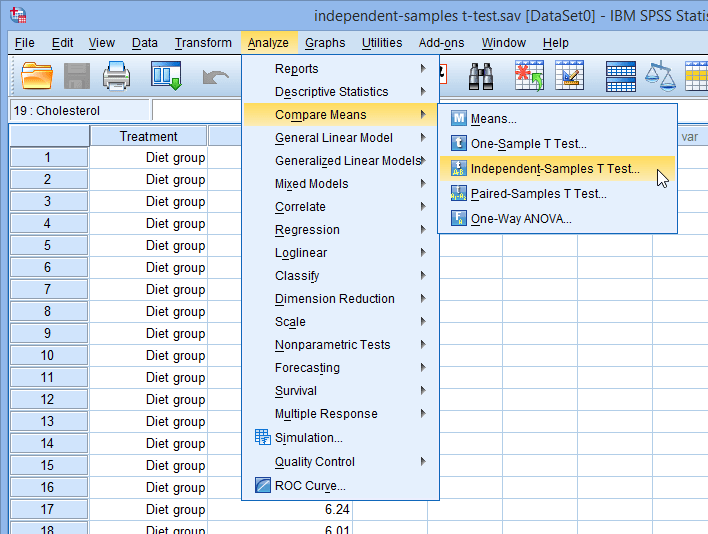
Why do we use an independent t-test?
The Independent t-Test is a parametric test. One of the simplest research designs involves the comparison of mean scores on a quantitative Y outcome between two groups; membership in each of the two groups is identified by each person’s score on a categorical X variable that identifies membership in one of just two groups. The groups may be naturally occurring (e.g. male vs. female). Alternatively, in an experimental study, groups are often formed by random assignment and given different treatments. The predictor variable (X) in these research situations is a dichotomous group membership variable. A dichotomous variable has only two values; the values of X are labels for group membership. For example, the X predictor variable could be dosage level in an experimental drug study (coded 1 = no caffeine, 2 = 150 mg of caffeine). The specific numerical values used to label groups make no difference in the results; small integers are usually chosen as values for X, for convenience. The outcome variable (Y) for an independent samples t-test is quantitative, for example, anxiety score or heart rate (HR).
What is the null hypothesis for an independent t-test?
In summary, the signal (the difference between the two groups’ means) in a controlled experiment must exceed the noise (within-group variation) for us to determine that the independent variable had a genuine effect on the dependent variable. In terms of hypothesis testing, the null and alternative hypotheses for the controlled experiment would be
H0: μ1 = μ2
Ha: μ1 ≠ μ2
where μ1 = the mean of a dependent variable for Group 1, and μ2 = the mean of the same dependent variable
for Group 2.
These mean population values will actually be tested with sample means drawn from these population values.
What are the assumptions for an independent t-test?
Specific assumptions must be met to use the t-test appropriately. They are as follows:
1. Independent Groups
The participants must be different in each group; that is, no participant is allowed to serve in both groups. There is another form of the t-test, the dependent groups’ t-test, that does assume that the participants are the same in each group.
2. Normality of the Dependent Variable
The t-test and its critical values are based on the assumption that the sample dependent variable values come from a population of values that are normally distributed. However, the t test’s value is enhanced because it is still a fairly reliable measure even for nonnormal but still mound-shaped distributions. An interesting characteristic of the t-test is that it is robust. The robustness of a statistical test means that its assumptions may be violated to some extent, yet the correct statistical decision will still be made, which is to correctly reject or fail to reject the null hypothesis.
3. Homogeneity of Variance
While we may expect the means to be different between two groups in a t-test, the assumption is made that the variances of the two groups about their respective means will be equal or approximately equal no matter whether the two groups’ means are different or not. In reality, this assumption is often a safe one. It is actually rare that the variances of two groups are radically unequal.
Our statisticians take it all in their stride and will produce the clever result you’re looking for.


